Plant Health
Published
Biostimulant application with drones: benefits and field results
Mauro Bernal, specialist at Bioiberica Plant Health, discusses the potential, challenges and future of aerial biostimulant application in extensive crops
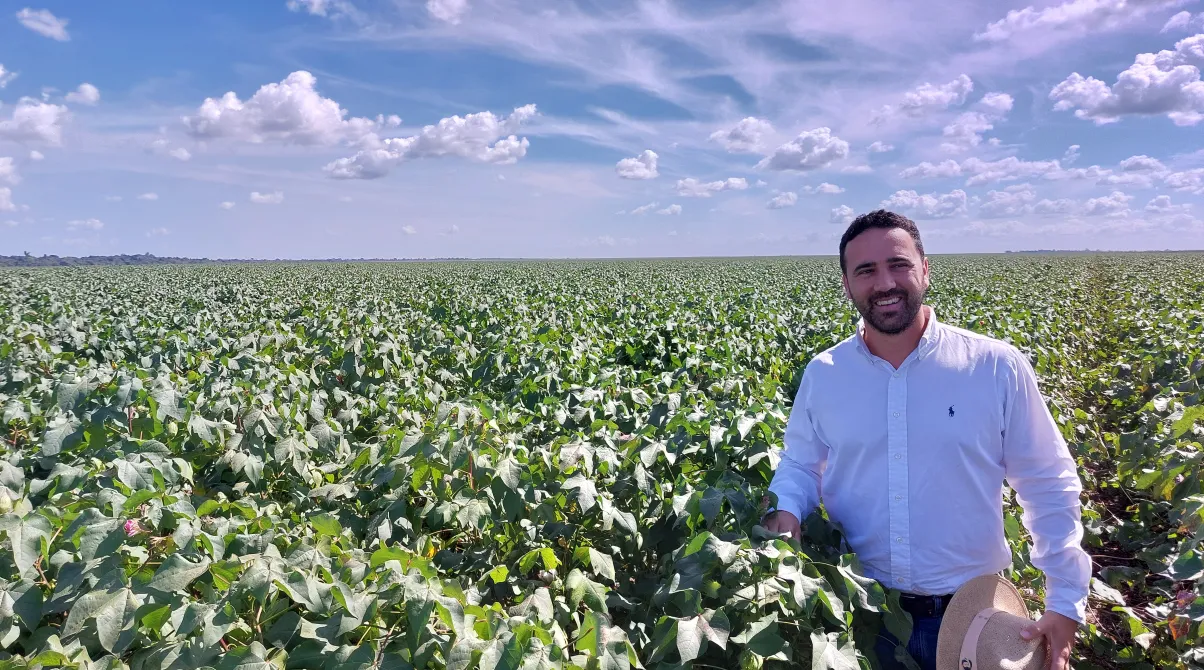
Mauro Bernal, Export & Crop Manager at Bioiberica Plant Health
“The driver behind this demand is crops where ground machinery access is difficult, such as rice, oil palm or maize at advanced phenological stages.”
Biostimulants are substances that, when applied to plants or soil, improve nutrient uptake, stress tolerance and crop quality. Their application using agricultural drones —also known as aerial spraying— makes it possible to reach crops at times and under conditions where conventional ground equipment cannot operate, optimising resource use and minimising environmental impact.
In this context, our biostimulants are demonstrating their compatibility and efficacy when applied via these aerial platforms.
To explore this topic further, we spoke with Mauro Bernal, Export & Crop Manager at Bioiberica Plant Health, who shares his experience on the aerial application of biostimulants, the technical challenges involved and the future outlook for this technology.
Which crops are driving demand for biostimulant application with drones?
The crops that benefit most from aerial biostimulant application with drones are those where ground machinery has limited access: rice (flooded fields), maize at the VT stage (male flowering, when crop height prevents equipment access) and oil palm (due to the plant’s structure and height).
- Demand began approximately eighteen months ago, when at Bioiberica we started to receive enquiries from clients and distributors seeking solutions compatible with this technology.
A prime example is maize during male flowering (VT stage), when crop height prevents the entry of conventional ground equipment, unless pivot irrigation systems or specialised vehicles such as Unimog are available.
In the case of rice, when fields are flooded, drone application is simpler and more cost-effective than any ground-based alternative. Other applications include crops where, simply for cost reasons, it is more economical to use this aerial platform.
Mauro Bernal, Export & Crop Manager at Bioiberica Plant Health
“New windows for foliar treatments are opening up where, culturally, they were never carried out before. And with them, a great opportunity to increase productivity.”
What technical challenges does biostimulant formulation for drones present?
The main technical challenge of biostimulant application with drones is dosing in low water volumes. Unlike conventional ground spraying, agricultural drones work with very low volumes, which significantly increases product concentration in the spray solution. Critical parameters include appropriate pH, low viscosity and, above all, excellent tank-mix compatibility with other formulated products.
Since concentrations relative to water volume are significantly higher than in ground application, the interaction between different products in the drone tank becomes a key factor.
According to Bernal, Bioiberica’s products have always stood out for their good tank-mix compatibility, although he acknowledges the need to continue gathering data under the specific conditions that this technology demands.
Recommendations for biostimulant application with drones
Once a product has been validated for drone use, at Bioiberica we provide specific recommendations to operators. These include dose guidelines adapted to low volumes, compatibility guidance with other products in the mix, and even the order in which different formulations should be added to the drone tank.
Regarding application timing, Bernal clarifies an important nuance: there is no phenological stage that is inherently more effective for drone application compared to ground spraying. The advantage of drones lies in the ability to access crops at times when other equipment cannot, and in the economic balance of the operation.
What agronomic results are achieved with biostimulants applied by drone?
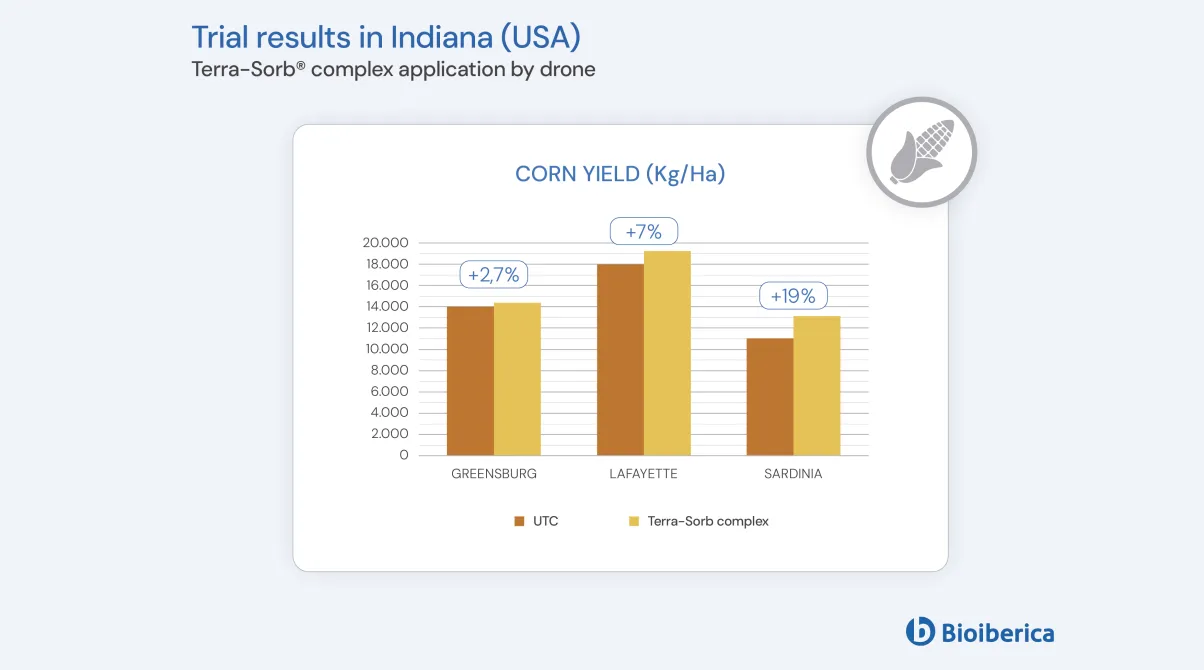
Trials conducted in Indiana (USA) with Terra-Sorb® complex (1.2 L/ha) applied by drone showed average yield increases of 1,220 kg/ha and a return on investment (ROI) of 29, figures that confirm the agronomic and economic potential of this application method. We assess a comprehensive set of indicators in our trials that goes well beyond yield.
Among the parameters measured are quality indicators specific to each crop (protein, oil yield, fruit size, fruit set percentage), as well as vegetative growth parameters such as NDVI, chlorophyll content and shoot length.
Regarding direct comparison with ground application, Bernal notes that, although rigorous scientific comparisons have not yet been carried out, the results obtained show no significant differences in efficacy.
Mauro Bernal, Export & Crop Manager at Bioiberica Plant Health
“Combining prior remote sensing flights for crop stress diagnosis with subsequent biostimulant application is a clear benefit, but it cannot be done in all situations and much of the sector is not yet at this level of technology adoption.”
Sustainability and drones: lower consumption, reduced environmental impact
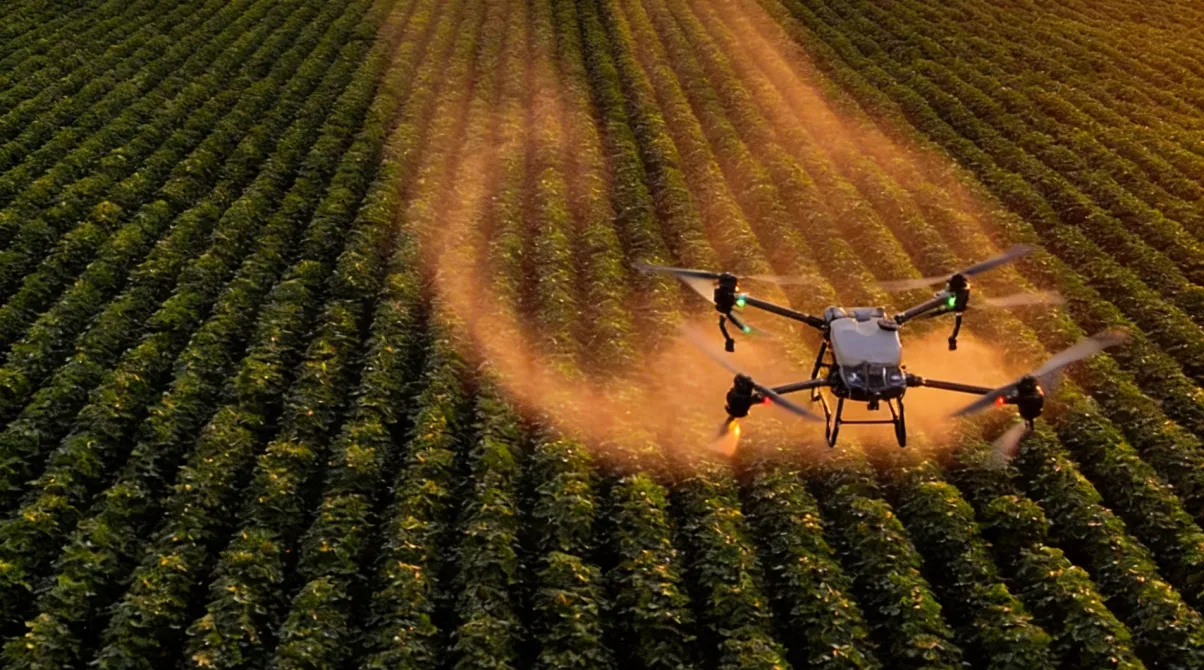
Aerial application with drones aligns directly with our sustainability and circular economy commitments. One of the most tangible benefits is the reduction in overall product doses applied, which translates into lower consumption of crop protection products and other inputs, with a positive economic and environmental impact. Furthermore, depending on the crop, low-altitude aerial spraying significantly reduces drift.
This resource-use efficiency fits naturally with our philosophy of making better use of inputs without generating waste, a principle that forms part of our commitment to the circular economy within the SARIA Group.
Remote sensing and biostimulants: towards precision agriculture with drones
One of the most promising opportunities in this field is combining remote sensing flights for crop stress diagnosis with the subsequent targeted application of biostimulants. However, Bernal points out that it is currently not possible to carry out both functions simultaneously on a single drone flight, and that much of the sector has not yet reached this level of technological integration.
Looking ahead, artificial intelligence will play a decisive role. Bernal anticipates that AI will enable the automation of application timing by zone and crop, making it possible for the system to operate without any prior operator experience, thereby democratising access to precision agriculture with drones.
Mauro Bernal, Export & Crop Manager en Bioiberica Plant Health
“The main role of AI will be the automation of application timing, which will be achievable without any prior experience from the people using these systems.”
Future of biostimulants with drones: adoption and new opportunities
The adoption of agricultural drone technology for biostimulant application is advancing most rapidly in regions with access to technology and where crops demand this type of platform due to inaccessibility. Medium-sized farms, between 50 and 500 hectares, are leading this transition, and Bernal clearly regards it as a technology that is complementary to traditional methods, not a replacement.
The main regulatory obstacle does not affect biostimulants themselves, but rather drone technology, which requires specific flight permits. This means that not all farmers can operate these platforms directly and must engage specialised service companies. Nevertheless, as more users obtain the relevant licences, the operator base will grow, and with it, demand for compatible biostimulants.
Perhaps the most significant development looking ahead is the opening of new foliar treatment windows that did not previously exist, with the consequent impact on crop productivity.
Innovation from the sky
Aerial biostimulant application by drone represents a strategic opportunity for more precise, efficient and sustainable agriculture. Bioiberica Plant Health, through innovation in our formulations and the development of tailored protocols, is actively contributing to this technological transition, offering solutions that combine technical compatibility with proven agronomic efficacy.
The key to success lies in understanding this technology for what it is: a complementary tool that broadens application possibilities, opens new foliar treatment windows and makes it possible to reach where conventional methods cannot.
For us, the future of biostimulation also lies in the sky.
Global Health Stories
All stories
Success stories, updates and news that explain how we work to improve the health and wellbeing of people, animals and plants.